
How Far Can a 5W Walkie Talkie Actually Reach? The Honest Truth About Radio Range
Look for the best long range walkie talkie online, and you'll instantly be bombarded with flashy listings promising "35+ miles range" or "massive 50-mile coverage." But anyone who actually uses two-way radios in the field knows a frustrating truth: once you leave the parking lot, that supposed walkie talkie long distance range often shrinks down to just a mile or two.
We believe in stripping away the marketing hype. Instead of feeding you fictional mileage, let's look at the actual physics and geometric realities of how a high-quality 5W (Watt) handheld radio performs in the real world—and what it really takes to get maximum range.
Why 5W Power is the Industry Sweet Spot
For a solid, reliable handheld radio, 5 Watts is the sweet spot. Compared to standard low-power 2-Watt consumer bubbles, a true 5W unit gives you the necessary punch to penetrate foliage and bounce signals around obstacles. More importantly, professional-grade 5W radios feature repeater compatibility. When terrain gets downright brutal, dropping your signal into a local repeater station is what actually doubles or triples your range—not extra wattage on your belt.
The Fictional Myth of 10W+ Handhelds
Lately, marketplace sites are flooded with ultra-cheap radios claiming 10W, 12W, or even 15W of power. It sounds great on paper, but physics doesn't care about marketing stickers.
Radio waves follow the Inverse-Square Law. To double your distance in open space, you don't need double the power—you need four times the power. Stepping up from 5W to a true 10W only gives you a theoretical range increase of roughly 41% in a perfect vacuum.
In the real world, that tiny boost is completely unnoticeable. A 10W signal gets absorbed by the exact same concrete structures and granite ridges that block a 5W signal. The only real-world difference you'll experience? Your battery drains twice as fast, and your radio gets hot enough to cook an egg. Reliable, professional-grade engineering focuses on antenna efficiency and clean receiver circuitry at 5W, rather than chasing battery-melting gimmicks.
Terrain Geometry: 5 Real-World Scenarios
The absolute deciding factor for two way radios long range performance is your surrounding geometry. Radio waves travel via line-of-sight. If you don't have a clear path to your partner, obstacles will take their toll.
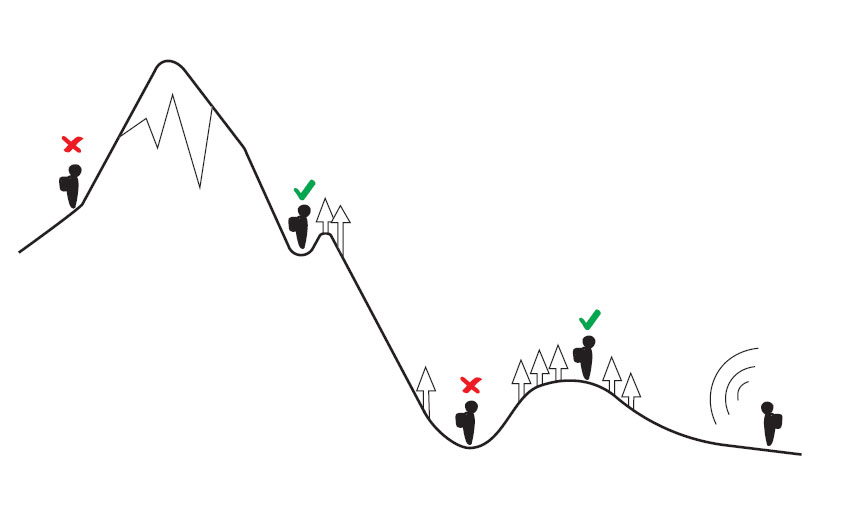
Real-world transmission paths: geometry always dictates your range limits.
| Environment | Realistic Range | What is Actually Happening? |
|---|---|---|
| Alpine (High Mountains) | 2 to 10 Miles | High vantage points and sparse tree lines offer excellent range. If you lack direct line-of-sight, waves can often bounce off facing mountain walls to reach the next valley. |
| Rolling Hills & Forests | 1 to 5 Miles | Highly deceptive terrain. While leaves absorb signal, the physical dirt of low rolling hills is the main obstacle. A ridge as low as 30 feet can completely cut off communication. |
| Rivers & Canyons | 0.5 to 3 Miles | Flat riverbanks with winding bends degrade signals quickly. However, steep canyons with solid rock walls act like waveguides, allowing signals to skip and bounce around deep bends. |
| Urban Environments | Up to 1.5 Miles | The absolute worst-case scenario. Concrete, steel, and tinted glass act like massive RF sponges. On top of that, background electrical noise heavily degrades your clear receiver performance. |
| True Line-of-Sight | 35+ Miles | Peak-to-peak mountain ridges or standing on an open desert plain. With zero physical obstructions in the first Fresnel zone, the radio easily achieves its maximum engineered limits. |
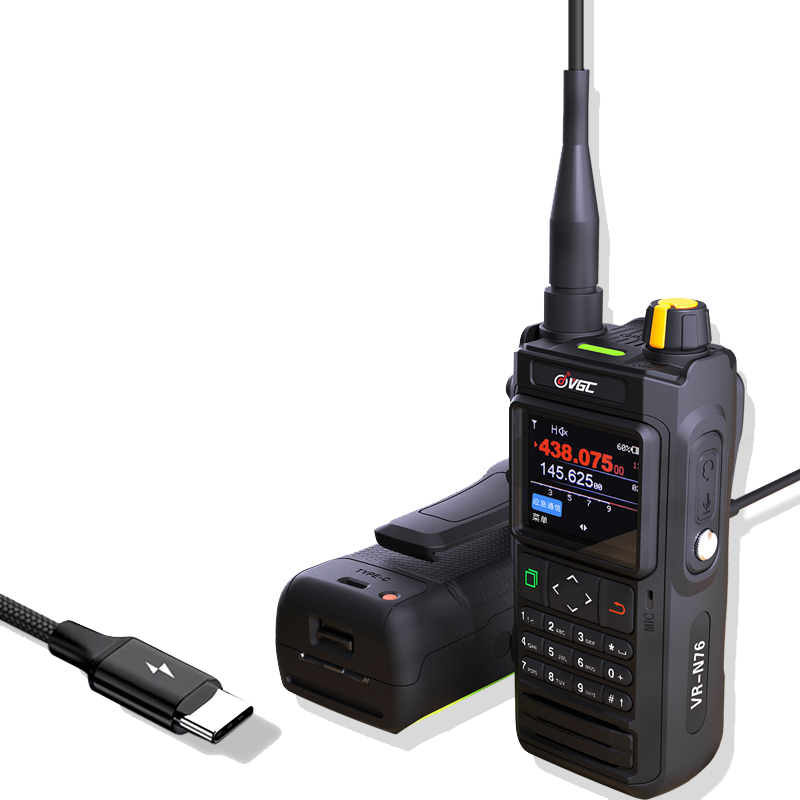
The Outdoor Workhorse: Vero Telecom VR-N76
If you want a rugged, dependable farthest range walkie talkie setup without the cheap gimmicks, the VR-N76 Handheld Radio is built for the job. It focuses on maximizing its highly efficient 5W output through a finely-tuned antenna system, rock-solid build quality, and true repeater capability to keep your team connected across hostile backcountry terrain.
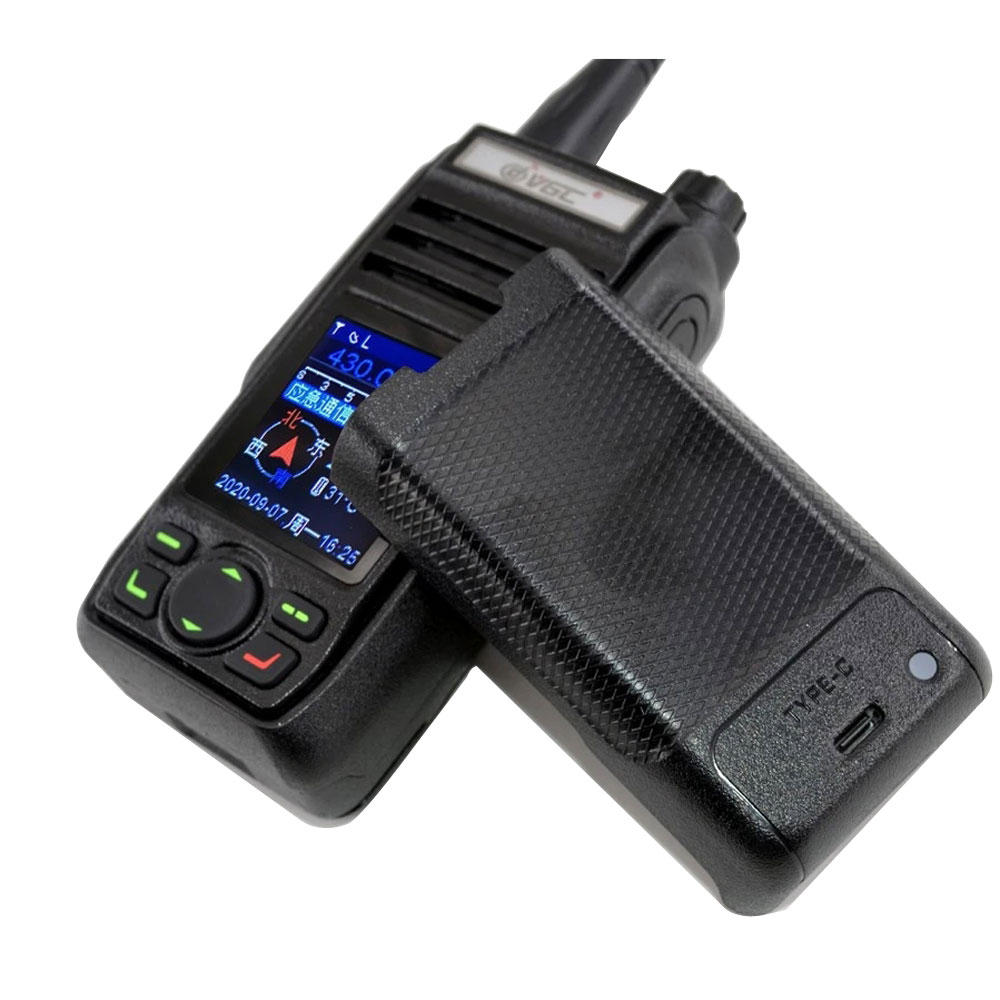
Smart Off-Grid Comms: Vero Telecom VR-N75
For overlanders and tactical teams who need intelligent tracking along with high-power hardware, the ultra-thin VR-N75 Smart Radio offers the perfect balance. Delivering an honest 5W output, it seamlessly pairs via Bluetooth to your smartphone for app-defined programming and real-world location sharing, all without burning through your field battery.
Bottom Line:
Stop looking at the raw wattage or the fictional numbers stamped on the retail box. When you are picking gear for hunting, overlanding, or emergency prep, look at the radio's antenna efficiency, build durability, and repeater architecture. True 5W units like the VR-N76 and VR-N75 will reliably pull signals out of tough geography long after fake 10W clones have overheated and died.